
From understanding our genomic traits to monitoring how diseases spread, genomic data has become a powerful tool for science and medicine. But analyzing this data quickly and accurately remains a major challenge. For example, sequencing human genomes on a global scale can often involve millions of gigabytes data.
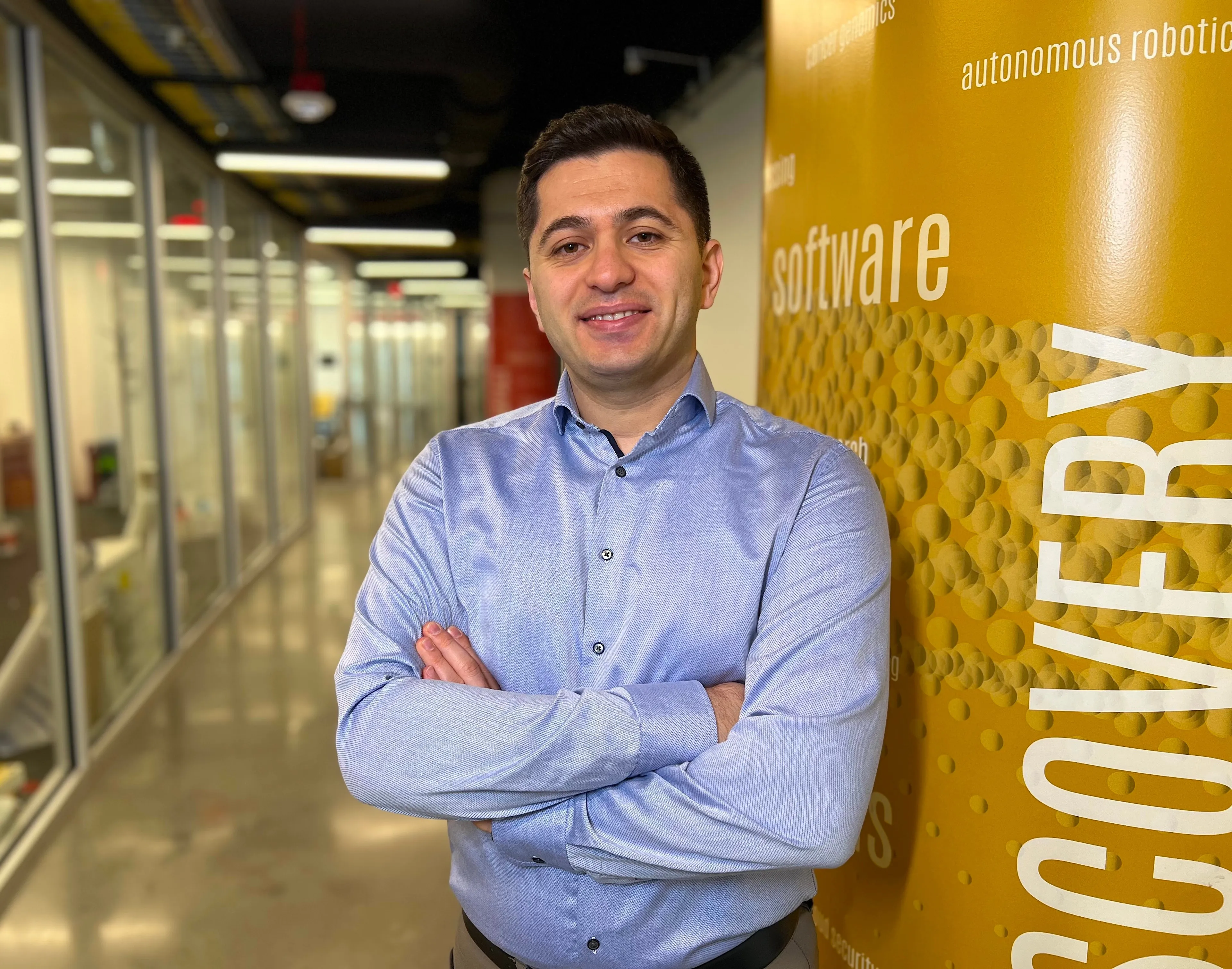
Can Firtina, who joined the University of Maryland in Fall 2025 as an assistant professor of computer science, is developing algorithmic and hardware-based solutions to make that process faster and more accessible.
He recently received an affiliate appointment in the University of Maryland Institute for Advanced Computer Studies (UMIACS), where he is active in the Center for Bioinformatics and Computational Biology (CBCB), which is supported by UMIACS.
Firtina’s work bridges computer architecture and bioinformatics, with a broader goal of expanding his research into actionable solutions to improve human health.
“We’re looking to unlock some transformative applications in medicine and health by substantially improving the scalability and accessibility of biological data analysis with algorithmic and specialized hardware design,” he says.
Firtina’s interest in computational biology started during his undergraduate studies at Bilkent University in Turkey, where he worked with a professor on designing computational solutions for bioinformatics.
“I was generally interested in biological data analysis because of its huge impact on human health and generally in life sciences,” Firtina says.
From there, he became active in solving the fundamental challenges of genomic data analysis that limit the accessibility in many important scenarios—from urgent genomic diagnosis for newborns in emergency care to continuous and scalable monitoring of human health and pathogens living amongst us.
“Providing solutions to such major problems usually requires co-designing algorithm and hardware together,” he says.
Firtina then went on to receive his master’s in computer engineering from Bilkent, and his Ph.D. in computer science from ETH Zurich in 2025. Recently, he received the ETH Doctoral Medal for 2025, which honors the best doctoral theses at ETH Zurich for his graduating year.
For much of his work, Firtina describes genomic data analysis as a massive jigsaw puzzle: each short fragment of DNA is like a puzzle piece whose origin is unknown. Researchers must determine where each piece fits, often moving huge amounts of data between the computer’s memory and processors to assemble and analyze the genome, which often creates substantial overhead in speed and energy consumption.
As he settles into his first year at UMD, Firtina hopes to extend his research further and work on several projects that focus on merging multiple steps and various data types in genome analysis to make the sequence-to-answer process smoother.
“We will look at how we can analyze raw genomic data such as electrical signals in a way that hasn’t been done before,” he explains. “We can do this by integrating these signals into the overall analysis together with other types of biological data such as proteins and spatial genomics data, to extract critical insights as effectively as possible.”
Many of these efforts, he adds, will also require understanding the computational bottlenecks to design portable and energy-efficient devices that can be used for continuous monitoring of health anytime and anywhere.
Firtina believes that his work aligns with UMIACS’ mission of diverse expertise from a variety of fields. He describes the faculty as “world-class” and is excited to collaborate with them, particularly with the CBCB and fellow UMIACS faculty members with expertise in computer architecture and high-performance computing such as Bahar Asgari and Uzi Vishkin.
He also is looking forward to the computational resources that UMIACS has to offer, saying that the institute’s computing infrastructure is “powerful and enormous, which is required for memory-intensive and computationally costly applications often found in bioinformatics.”
As the field of computational biology progresses, Firtina sees the intersection of computational architecture and computational biology becoming more prominent due to the pressing need to efficiently analyze increasing volume of genomic data.
Data-centric processing will become more important than ever, he says, predicting that future solutions will look toward emerging memory technologies such as processing-in-memory to minimize energy consumption and latency and to find novel answers to problems in AI and computational biology.
“I hope that our work will be impactful in other fields that are looking at similar types of data-centric architectures,” he says.
—Story by Zsana Hoskins, UMIACS communications group