
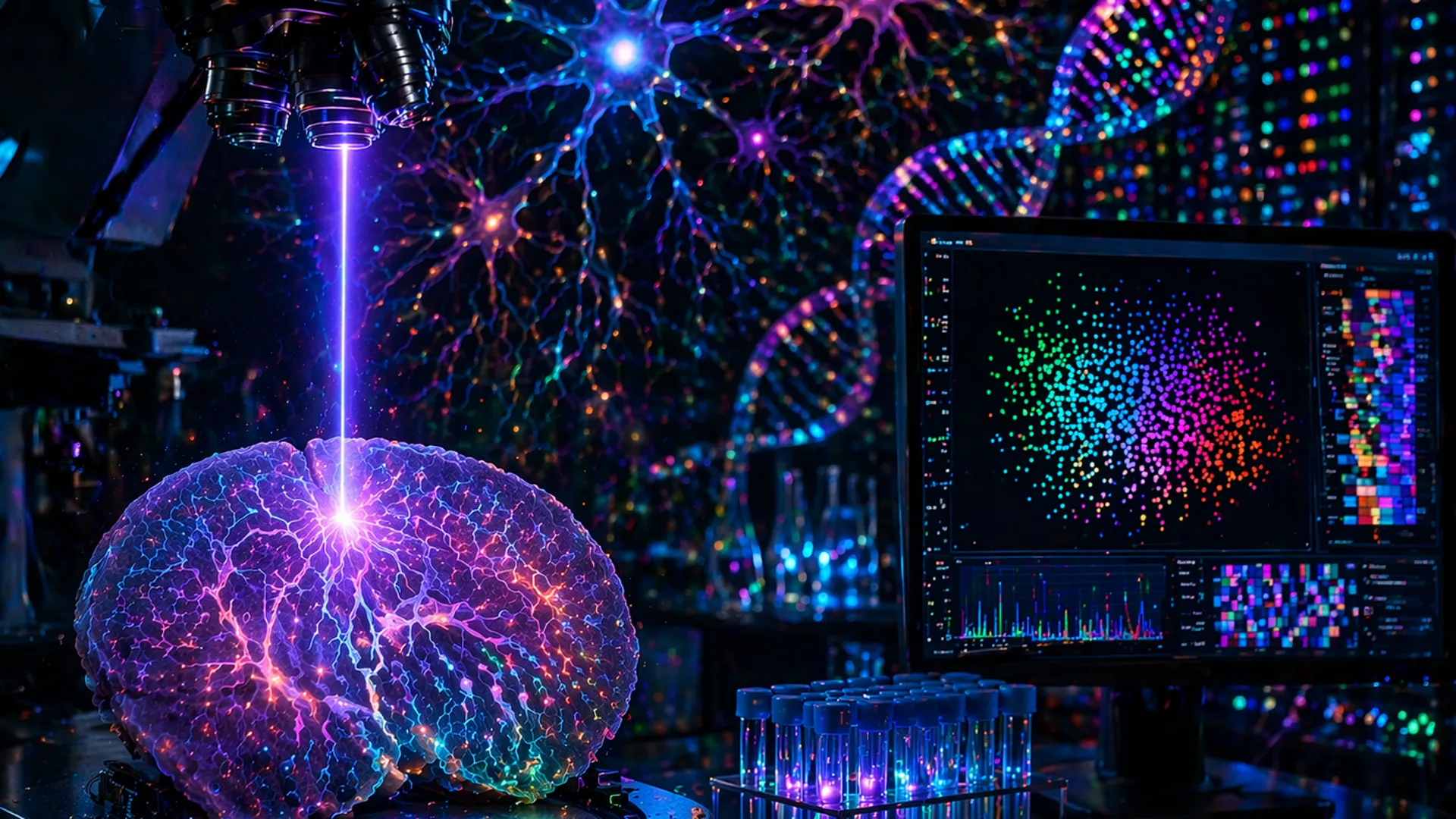
A team of University of Maryland researchers has received seed funding for a project that combines lasers with computational biology to explore new methods for tagging cells, with the goal of clarifying the relationship between neural activity and the genetic makeup of individual cells.
Rob Patro, an associate professor of computer science with an appointment in the University of Maryland Institute for Advanced Computer Studies (UMIACS), is collaborating on the project with Scott Juntti, an associate professor of biology who specializes in behavioral neuroscience.
Their interdisciplinary work is supported by a grant from UMD’s Brain and Behavior Institute (BBI)—one of three projects selected in 2026 to develop new tools for studying complex brain-driven behaviors. The BBI seed grant program, now in its ninth year, typically provides between $50,000 and $75,000 to support early-stage ideas that can lead to external funding.
Patro’s lab will develop computational classifiers to analyze RNA sequencing data, while Juntti’s lab will develop and optimize experimental protocols, conduct studies, and identify effective model systems.
“When you're developing a new technology and seeing specific signals in the analysis, you want to know whether they’re biologically plausible or artifacts of computation,” said Patro, who is also a core faculty member in the Center for Bioinformatics and Computational Biology. “Having that experimental expertise is invaluable.”
The project focuses on understanding how individual neurons differ in behavior at the single-cell level. While modern imaging tools can track neural activity, few methods allow researchers to tag cells in vivo and later analyze them comprehensively. As a result, researchers often must choose between observing activity or conducting detailed genetic analysis.
To address this limitation, the UMD team will test a laser-tagging technique that marks active neurons with light, enabling researchers to later decode their genetic identities. The approach is designed to be adaptable across a range of species and tissue types.
The researchers will also examine how tissues respond to treatments, using these observations to study how genetic variation influences cellular behavior. However, the scale of modern biological data presents significant computational challenges.
“Brain cells fall into many different classes that can be defined by which genes are turned on,” explained Juntti, an expert in behavioral neuroendocrinology. “But it is difficult to figure out what those genes are,” he added, “and the problem is further complicated when studying species for which genomic manipulations are not commonly made–including humans. We need not only the right tools, but the algorithms to interpret and explore the data, which is where the Patro Lab really excels.”
Patro will use UMIACS’ Nexus cluster to process large single-cell sequencing datasets, with the shared infrastructure already facilitating data exchange between the two labs. “The problem is very complex when you consider the scale of the data,” Patro said. “Developing efficient classifiers helps ensure the signals we see are reliable and not artifacts.”
Patro emphasized that much of the work is driven by students in his lab. “The day-to-day research and many of the ideas come from the students,” he said.
The project will focus on building and testing the laser-tagging and analysis pipeline, with early results expected to evaluate how reliably the method can mark and recover specific cells, with the goal of eventually connecting neural activity to gene expression at the single-cell level.
—Story by Diya Sharma, UMIACS communications group